

Denis Sergeevich Sekirinsky, Deputy Minister of Science and Higher Education of the Russian Federation, visited IPMash RAS
On June 3, 2026, Denis Sergeevich Sekirinsky, Deputy Minister of Science and Higher Education of the Russian Federation, visited the Institute for Problems in Mechanical Engineering of the Russian Academy of Sciences. During the visit, Vladimir Anatolyevich Polyansky, Acting Director of the Institute, presented the key results of IPMash RAS activities and the main scientific plans.
Denis Sergeevich was shown the specific applied results and research directions of the laboratories: Laboratory of Structural and Phase Transformations in Condensed Media, Control of Complex Systems, Laboratory of Adaptive and Intelligent Control of Network and Distributed Systems (AdIn), as well as of the laboratory created within the framework of the megagrant Digitalization, analysis and synthesis of complex mechanical systems, networks and environments. Currently, the scientific staff of the Institute continues to work on new research areas.
In particular, with the following results were presented to the Deputy Minister: Development of a unique synthesis method for special cubic silicon carbide (3C-SiC/Si) substrates designed to create high-frequency HEMT transistors based on gallium and aluminum nitrides. In 2025, a complete technological chain for the synthesis of SiC/Si plates with a diameter of up to 150 mm was implemented: a new reactor was developed and built, as well as an ISO7–8 class clean room.
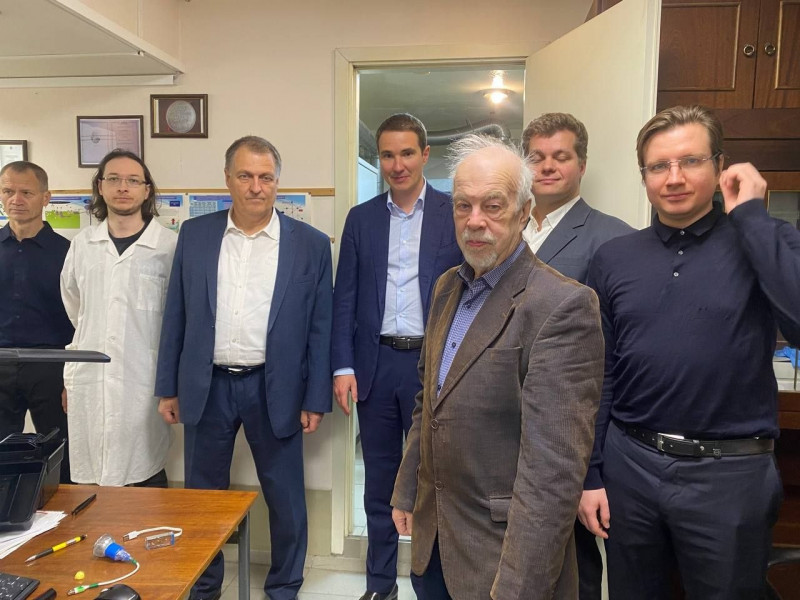
Vladimir Anatolyevich Polyansky, Denis Sergeevich Sekirinsky, Sergey Arsenyevich Kukushkin and the staff of his Laboratory of Structural and Phase Transformations in Condensed Media
Intelligent control, reliability and safety of complex technical systems. The theoretical foundations of digital and intelligent control of a range of complex mechanical objects, including vibration installations and mobile robotic complexes, were created. New algorithms were proposed for estimating states and parameters of brain activity models based on real measurements for several types of mathematical models of neurons and neural ensembles, including algorithms and programs for direct neural interface control of a wheelchair. The results obtained can be used to create modern digital management and information processing tools.
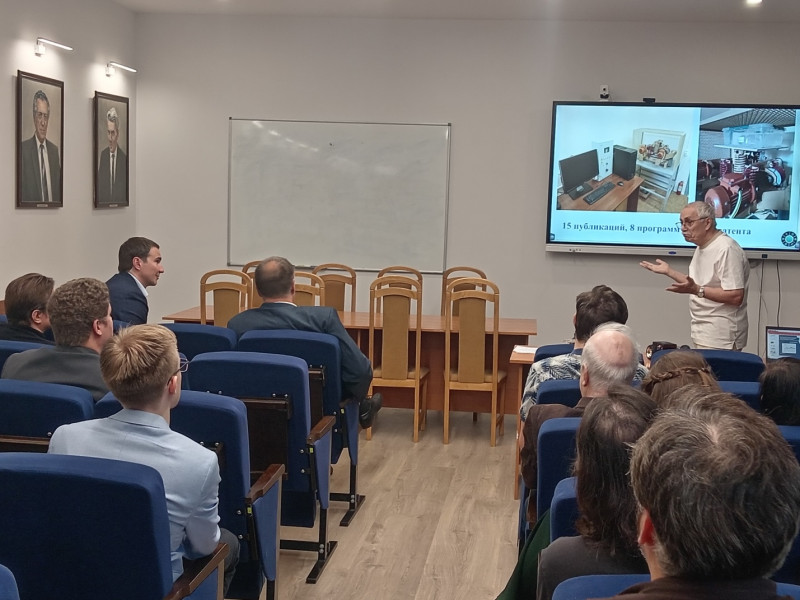
Presentation by Alexander Lvovich Fradkov, Head of the Complex Systems Management Laboratory, Professor, Doctor of Technical Sciences
Adaptive and Intelligent Control of Network and Distributed Systems by using the theory of divergent stability and artificial intelligence methods. New methods of control, evaluation and observation in conditions of uncertainty, perturbation and delay were developed, which have wide practical application. The algorithms and software created on their basis were implemented for the current assessment of the crude oil, water and gas content in the oil pipeline at the fields based on information obtained only from vibration sensors. These methods can also be effectively used in the development of control algorithms that reduce vibrations in passenger trains and increase the wear resistance of train elements.
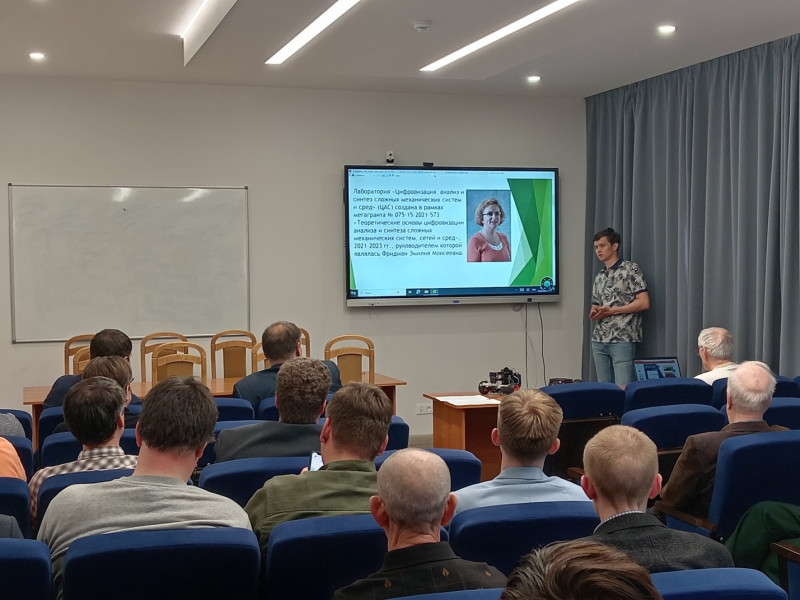
Presentation by Sergey Aleksandrovich Plotnikov, Head of the Laboratory Digitalization, Analysis and Synthesis of Complex Mechanical Systems, Networks and Environments, Senior Researcher, Cand. Sc Physics and Mathematics