

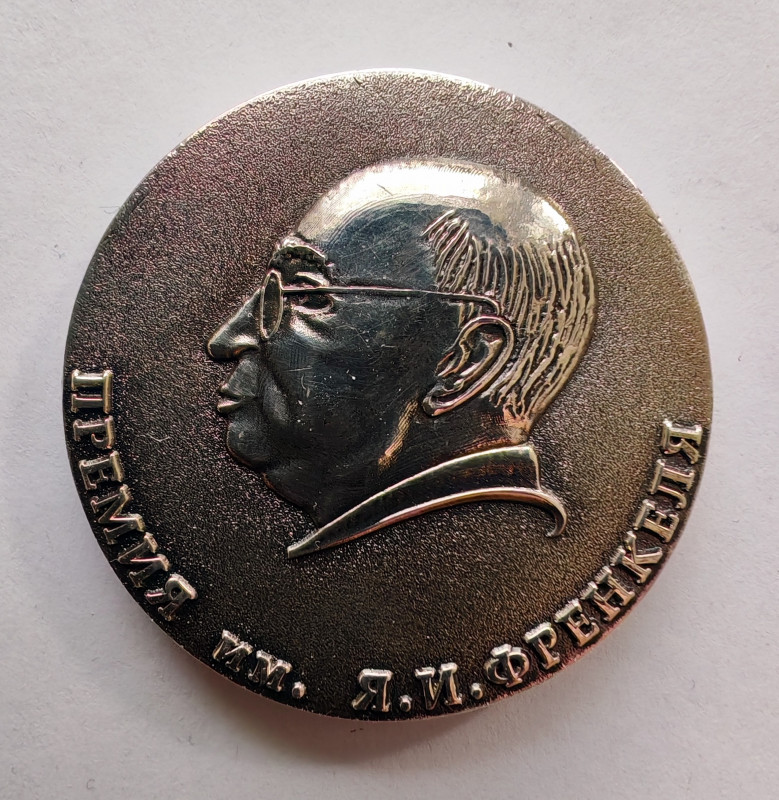
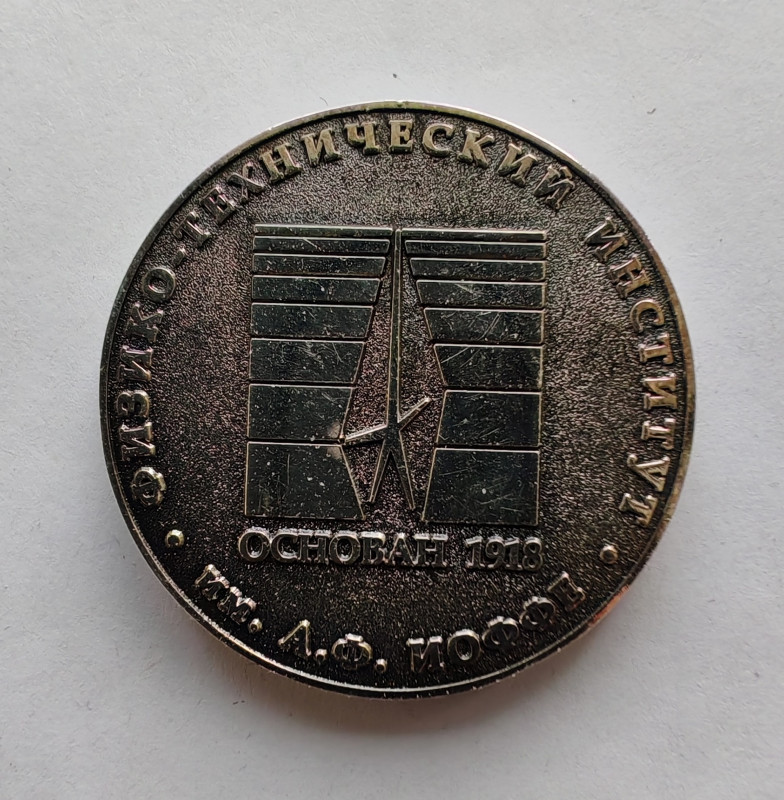
Congratulations to Mikhail Yuryevich Gutkin on receiving the Ya.I. Frenkel Award
A series of 24 papers submitted for the competition was carried out by a research team led by T.S. Orlova, Dr Sc. Physics and Mathematics, Chief Researcher at the Laboratory of Physics of Profiled Crystals at the A.F. Ioffe Institute of Physics and Technology, and M.Yu. Gutkin, Dr Sc. Physics and Mathematics., Chief Researcher at the IPMash RAS Laboratory of Nanomaterial Mechanics and Defect Theory, is devoted to solving the important problem of finding methods for improving the strength and ductility characteristics of aluminum alloys simultaneously.
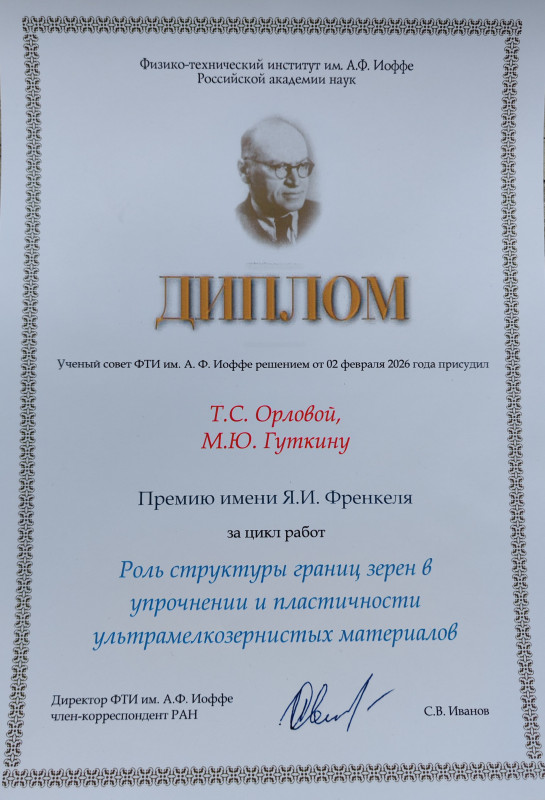
Currently, an increase in the strength of the alloy is achieved by significant (by orders of magnitude) grinding of its grain by various methods of intensive plastic deformation, however, this leads to a sharp (at times) decrease in the ductility of the alloy, and this makes it practically unsuitable for industrial applications.
In the works of T.S. Orlova and M.Yu. Gutkin, the results of experimental and theoretical studies are presented, from which it follows that the problem of combining high strength and sufficient plasticity can be solved using special methods of additional thermal deformation treatment of an alloy having an ultrafine-grained (UFG) structure.
It is shown that, under conditions of severely limited intragrain dislocation plasticity, which is characteristic of UFG metals and alloys, a key role as a source of dislocations is played by grain boundaries saturated with various defects — excessive grain boundary dislocations, segregation of alloy alloying elements, and nanoscale precipitates of the second phase — nanoprecipitates. The behavior of this complex defective grain boundary structure can be controlled by alternating short-term annealing and additional small plastic deformation.
Annealing leads to the annihilation of excess dislocations and to an increase in the critical stresses of dislocation emission from the boundary into the grain body, i.e., to the hardening of the alloy, and additional deformation sessions lead to the saturation of grain boundaries with new excess dislocations. When loading the alloy, this leads to a decrease in such critical stresses and to the emission of a large number of new dislocations into the grains, i.e., to an increase in the ductility of the alloy. The experiments carried out and the theoretical models developed create a clear picture of the processes taking place with that.
It becomes possible to control purposefully both the defective structure of grain boundaries and their ability to promote the hardening and plasticization of the alloy, that makes it possible to achieve both its high strength and sufficient plasticity.
As a result, priority strength and ductility characteristics were obtained experimentally for all the studied aluminum alloys. It is important that the approaches and models proposed by the authors for aluminum alloys can be applied to another UFG metals and alloys.
The scientific level of the conducted research is also indicated by the fact that 11 papers of the cycle were published in journals of the 1st quartile, 6 papers — in journals of the 2nd quartile.